
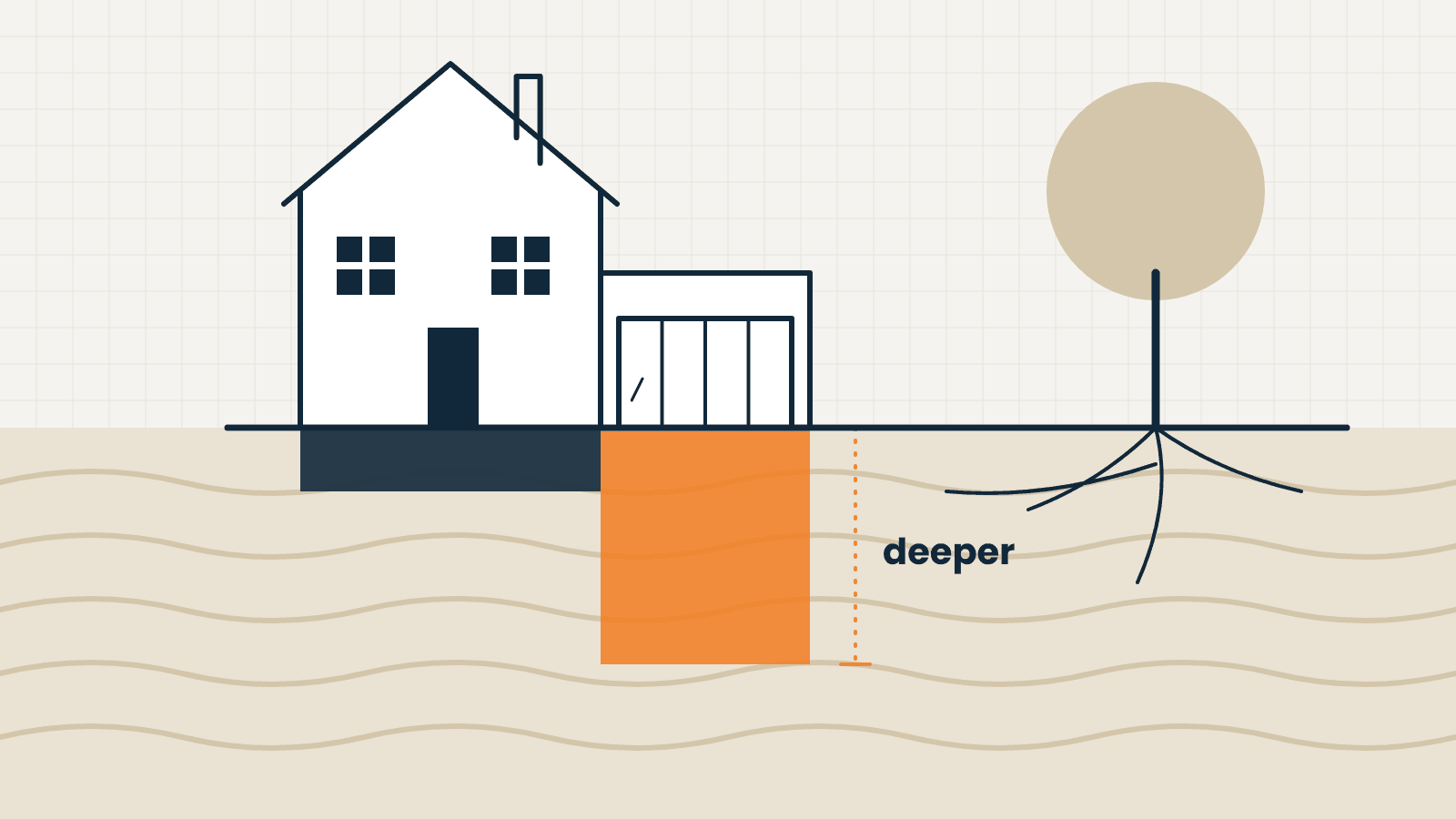
Short answer: clay shrinks when it dries out and swells when it gets wet, and trees and hedges dry it out. Near trees, extension foundations on clay are dug deeper, sometimes over 2 metres, or replaced with piles and heave protection. Building Control and your engineer confirm the depth once the ground is dug.
Why it matters in the RH area
The British Geological Survey calls shrink-swell the most damaging geohazard in Britain. The clays most prone to it are in the South East, where they’re too young to have hardened into stronger mudrock. Much of the Low Weald around Horsham, Crawley and Burgess Hill is on clay, and there are bands of clay along the foot of the North Downs too. You can check your own address on the BGS geology maps.
Recent summers have made it more pressing. Insurers paid £307 million for domestic subsidence in 2025, 10% more than 2024 and the most since the ABI started collecting the figure in 2017, and summer 2026 brought record heat and dry ground across England.
What decides how deep the foundations go
- The clay itself: some clays move much more than others. A soil test measures this (the plasticity index).
- Trees and hedges: the species, its height when fully grown, and how close it is. Oak, willow and poplar take the most water. Neighbours’ trees count too.
- Trees that have been removed: when a large tree comes out, the clay slowly takes up water and swells (heave), which can lift a new foundation.
- The existing house: your engineer will want the extension to move with the house, not against it, so the existing foundation depth matters.
As a rough guide, on clay with no trees nearby, foundations of around a metre are typical. Near large trees they can go past 2 metres, and beyond about 2.5 metres an engineer usually designs piles or a reinforced raft instead of deeper concrete.
Before you fell a tree
The BGS advises against removing mature trees that are older than the house without advice, because the ground can heave as it rehydrates. Reducing or thinning the crown can be a better option. In a conservation area, or where a tree has a preservation order, you must tell the council or get consent before doing any work to it.
What it does to the budget
- Deeper trench foundations use much more concrete and create more spoil to take away.
- Heave protection, such as compressible boards along the trench sides and a suspended floor, adds materials and time.
- Piled foundations need a specialist rig and an engineer’s design.
- A trial pit or soil investigation before you get a final price is the best way to avoid surprises.
Ask any builder how their quote handles foundations: the depth they’ve allowed for and how extra depth will be charged. Our extension cost guide explains what else goes into the price.
Signs to watch in your existing house
Diagonal cracks that widen towards the top of a wall, often near doors and windows, doors and windows that start sticking, and gaps opening where an old extension meets the house can all point to ground movement. If you see them, tell your insurer early, before starting any building work.
Questions people ask
How deep do extension foundations need to be on clay?
Usually about a metre on clay with no trees nearby, and much deeper near trees. Your engineer and Building Control set the final depth when the trench is open.
Should I cut down a tree before I extend?
Not without advice. Removing a large established tree can make clay swell and push foundations up. Check for a tree preservation order or conservation area first.
Do I need to tell my insurer about an extension?
Yes. Tell them before work starts. Many policies need to know about building work, and some ask about trees close to the house.
We check trees, drains and ground conditions on every survey visit for extensions. Book a survey visit or call 07802 758763.
Sources
- British Geological Survey: Shrinking and swelling soils
- British Geological Survey: Six ways to prepare your home for subsidence
- British Geological Survey: Shrink-swell property hazard information
- Milliman: UK property insurance subsidence 2026, citing ABI data
Last checked: 27 November 2026. Rules, grants and fees change; check the linked sources before you rely on them.